Category: Walt Disney World

  • Expedition Everest Challenge, Part 2: The Run

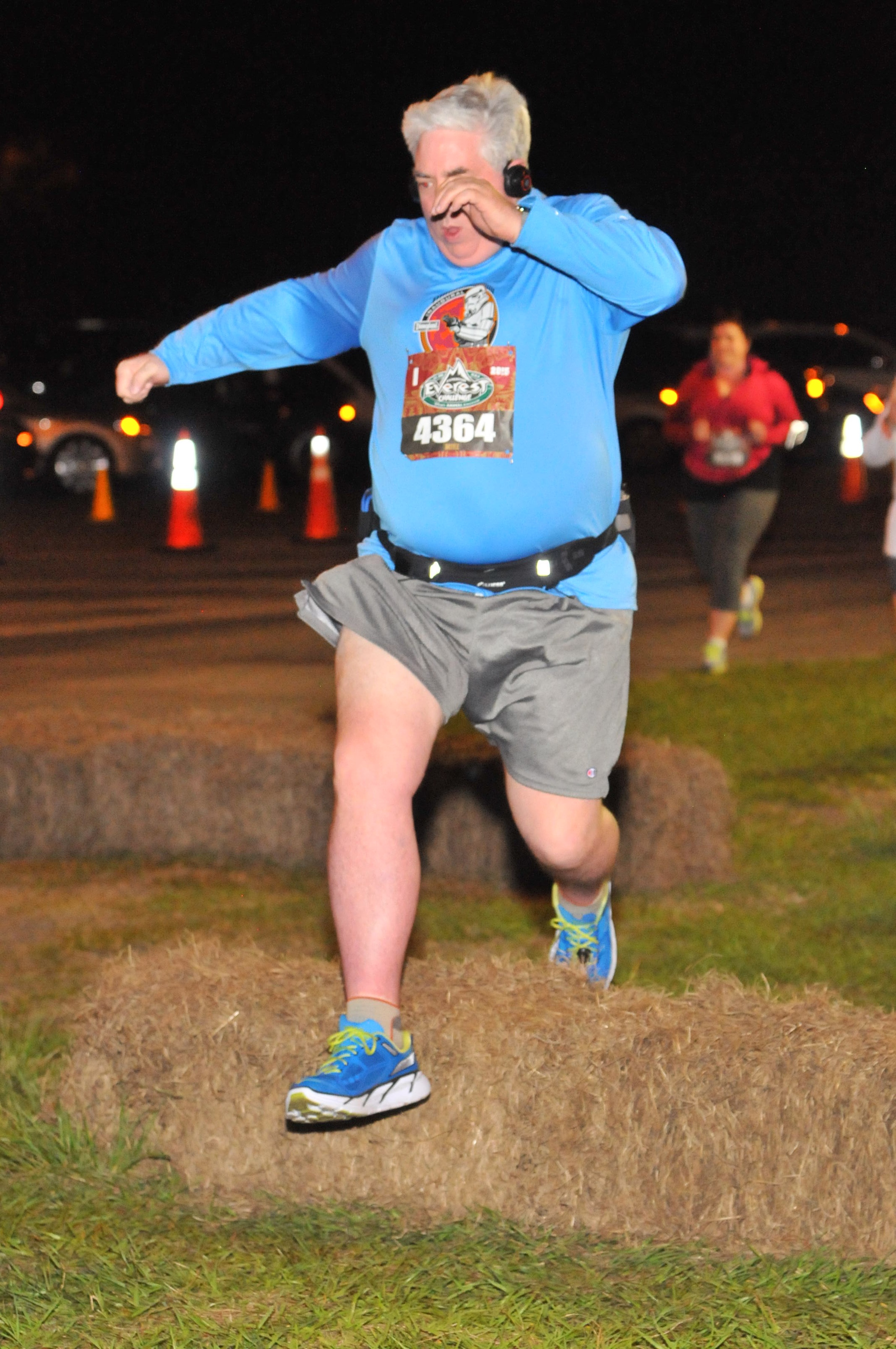
    The run portion of the Expedition Everest Challenge is a 5K.  Our course started out by running around the circumference of the Animal Kingdom parking lot.   This portion of the run made up approximately a mile of the 5K course.   Just before we reached the park entrance, we came to the first of 3 obstacles along the course — the hay bales.   These were pretty low — probably a foot high and a foot long.   It would certainly be possible to just step over them, but I got into the spirit of the challenge and tried to take them at speed.

    The first obstacle - Hay Bales
    The first obstacle – Hay Bales

    Soon after that I was at the 1 mile marker.   I was running with the new Apple Watch, and had decided to try to workout app on the watch rather than running with the Garmin that I usually use.   I was a little concerned that we hit the 1 mile marker while the watch showed me still well short of a mile (I think about .8).   After the race, I learned from other runners that it wasn’t my watch — the course was not officially certified and was in fact quite a bit short (somewhere in the 2.7 – 2.8 mile range).   That’s a surprisingly large miss even for a non-certified course.

    Our course through the park was essentially a clockwise lap around the park — through the Oasis, left in front of the Tree of Life into Africa / Harambe, then cutting across to Asia and the Expedition Everest area.   Our path then took us into backstage areas.   There was a long out-and-back stretch along a roadway, and here we came to the second obstacle, which was to crawl under netting.   Fortunately this was on clean dry grass so it wasn’t too tough, although it was surprisingly exhausting and I really felt glad to get back to my feet at the far end.

    Coming out of the second obstacle
    Coming out of the second obstacle

    At this point, continuing on the roadway away from the Animal Kingdom, I was overtaken by a couple of riders on bicycles.   Other runners were alerting everyone to move right so the riders could get by.   Someone said ‘Fire Department’; I’m not sure if that was correct but they were certainly EMTs from somewhere, as within a minute of them passing me I came upon the scene where they were performing CPR on a runner.   I heard conflicting stories about the outcome, so I’m not sure if he was OK or not.   I certainly hope that it turned out OK.

    After we finished the out-and-back leg of the course on the roadway, we turned left and merged with runners who were finishing up the ‘scavenger hunt’ portion of the challenge which comes after the 5K.   At this point there were signs and recorded audio telling runners to merge to the right, and scavengers to merge to the left.   After this, it was a turn into the finish chute for the run.    But unlike other races, when you finish the run, you’re far from done (and there is no medal awaiting you for “just” finishing the 5K).   There was a stop for water bottles, and then race volunteers handing out sharpies with small LED flashlights attached.   Then you picked up your first clue for the scavenger hunt.

    The details of the scavenger hunt will be in the third and final Expedition Everest Challenge recap post.

  • D23 Expo 2013: Highlights from the Imagineering Panels

    Sunday at the D23 Expo was Imagineering day.    Early on, when schedule details were first being announced, it was revealed that there would be five Imagineering sessions on Sunday, but it wasn’t until the last week or so before the Expo kicked off that attendees were given any information about the sessions.

    The sessions were similar in that each one was a panel, and the panels were somewhat more free-form than other panels and presentations.    As a result, there was some overlap, and in reviewing my notes, I felt it would be better to just combine my notes and create a single blog post for the three panels I was able to attend  (attending the Disney Infinity presentation required me to miss the other two Imagineering panels.   I’ve also included a few items from Marty Sklar’s solo presentation on Friday, which I had not previously written up.

    The Panels

    The three panels I attended on Sunday were:

    Working with Walt, with panelists

    • Marty Sklar.  Disney Legend; Currently International Ambassador for Walt Disney Imagineering; previously VP of Concepts and Planning, Vice Chairman and Principal Creative Executive.   Among many other things, guided the creative development of Epcot.
    • X Atencio.   Disney Legend.   Wrote the story for attractions such as the Haunted Mansion and Pirates of the Caribbean; also wrote the songs “A Pirate’s Life for Me” and “Grim Grinning Ghosts”.
    • Alice Davis.   Disney Legend.   A costume designer for attractions such as it’s a small world and Pirates of the Caribbean, as well as Disney films and television.   Widow of Disney Legend Marc Davis.
    • Bob Gurr.  Disney Legend.   Designer of ride vehicles including Autopia cars, the OmniMover system (Doom Buggies and similar), Matterhorn Bobsleds, Submarine Voyage submarines, and the Disneyland Monorail.

    Leading a Legacy, with panelists

    • Marty Sklar.   See above
    • Bruce Vaughn, Chief Creative Executive, Walt Disney Imagineering

    Leave Em Laughing, with panelists

    • Dave Fisher, show writer
    • Kevin Rafferty, story development, senior concept writer
    • George Scribner, story development, director
    • Joe Lanzisero, Creative VP for Tokyo Disneyland
    • Jason Surrell, show writer and producer

    The Content

    Here are some of the things that I thought worth jotting down notes about during these presentations

    (Marty)  The last time Walt appeared on film (October 1966) was in the much-shown introduction to “the Florida Project”, where Walt introduced the plans for what would become Walt Disney World, including EPCOT.   Marty was the writer for this.

    (Alice)  The first time she met Walt was when she was having dinner with her husband Marc at the Tam.   (Tam O’Shanter, a restaurant near the studios popular with studio personnel).   Walt asked about her work.   She was in the garment industry — making girdles and brassieres.   Walt was fascinated (and as far as I can tell she was relating this entirely seriously) by her expertise with elastic.   Two years later, Walt called and asked her to do costumes for it’s a small world.

    (Bob) Asked about first time meeting Walt, he said he was doing sketches for the Autopia cars.   Someone came through the office and took a look, and it wasn’t until he was on his way out and someone said “bye, Walt” that Bob realized who it was.   He thought maybe it was a night watchman or something, so I guess it must have happened after hours.

    (Marty)  His first job at Disney was to produce a tabloid-style newspaper that would be sold on Main Street for ten cents.    It showed how, for Walt, Main Street was a real place, not just a mock-up.   No real small town of that era would be without a newspaper, so there had to be one or the story wouldn’t be right.

    (Bob)  When doing the Lincoln animatronic, Walt had an actor do the speech, and filmed it as a reference.   Bob felt the first take done by the actor was excellent.   But Walt kept making him do it over, and over.  He knew what he wanted and kept pushing (but wasn’t giving any direction to the actor, just having him do it again).   The last take was the one Walt wanted.  The actor was clearly exhausted by that point, and Walt felt that was the way Lincoln would have been at Gettysburg.   That was the kind of authenticity that Walt looked for.

    (Alice)  Making the dolls for it’s a small world, at some point she told Walt that no one had told her how much she could spend on each costume for fabric, buttons, etc.   Walt told her he had a building full of people to do “pencil work”, that she was to design the best costume that anyone from 1 to 100 would love to wear, and they (the pencil people) would figure out how to pay for it.   “People will know the difference; give them your best and they’ll be back.  Cheat them and you’ll never see hide nor hair of them again”.

    (X)  After 20+ years in animation, Walt brought him over to do the script for Pirates.   Marty asked, having never done a script, why did Walt trust you to do that?   X: it was a direct command performance from the man himself.

    (Bob) Walt was never interested in what you had done, but only in what you were going to do next.

    (Alice) Walt would give you something you didn’t think you were capable of doing.  And you’d find a way to do it, because you didn’t want to disappoint Walt.

    (Bob)  Walt remembered almost everything he ever heard, if you told him something, and came back with a different story later, he’d call you on it.

    (Alice)  A young man came to Walt with a drawing and asked him “what do you think of this”?   After looking for a moment, Walt said “It’s very difficult to choose between one”.   He always wanted options.

    (Marty)  The job of leading Imagineering is largely a job as a casting director.   For example, Marc Davis and Claude Coats were very different – they wouldn’t be caught dead going to lunch together.    (Not anything negative, they were just very different).   But putting them together created a really complementary team.

    With the Haunted Mansion, Claude felt it should be scary, and Marc thought it should be funny.    The back and forth between them gave us the ride we have today, probably better than if we had gotten just Marc’s version or Claude’s version.

    (Marty) asked about how to train for a job in Imagineering, Marty suggested learning as much as you can about as many things as you can.   Imagineering comprises 140 different disciplines (but Marty acknowledges they don’t really know how many, that’s just the number they use).   Cross-disciplinary skills are a must.

    (Marty)  leading Imagineering is about casting, motivation, and gently helping someone understand when they have the wrong idea (“a bit of an art form”)

    (Marty or Bruce — didn’t note)  An interesting thing with Hong Kong Disneyland (Shanghai will be similar) is that because of the one child law, the kid-to-adult ratio is inverted from other worldwide parks; influences a lot of what you do in park design.

    (Bruce)  told a funny story about World of Color.   After investing millions in this very advanced fountain system, they decided to create new versions of many classic Disney songs.  So they had the London Symphony Orchestra record a brand new score for the show.   And when they first tried it out, it just wasn’t working.   Someone even said “what if fountains are just boring?” after they had invested tremendous time and money in the show.   Then, they dropped in the classic music (the arrangements we all know)  — and immediately it worked.   We are just really wired to respond to that music the way we know it.

    Someone from the audience asked about Harry Potter at Universal; Bruce didn’t really rise to the us vs. them challenge, but used the question to re-affirm that it’s all about story — that ride, that area of the park is so powerful because it starts with a great story.

    (not sure who told this one)  When Disneyland was about 6 years old, Walt sent Marc Davis over since he was between projects.   Walt asked what he thought, and Marc said what was missing was humor.   So Marc added things like the men climbing the tree to get away from the rhino in the Jungle Cruise.   (and apparently the original Jungle Cruise script was not funny;  it appears from history that the script got punched up at about the same time Marc began working in the parks).

    (Kevin)  The version of one of the songs at Mater’s Junkyard Jamboree where Mater forgets the words to the song was completely intentional  (which is different than the story I’d heard about it previously).    The story is, when Kevin was demoing the song for Larry the Cable Guy (voice of Mater), he actually did forget some words and filled in with a “something something something”   — Larry said “we have to do that!” and did it in one take.

    (Kevin)  Mater’s Junkyard Jamboree also is the first ride to have a “Joke” button; when the ride is loading, if it is taking a little longer than ideal, the operator can hit a “joke” button on the console and Mater tells a joke.    He played a number of the recorded jokes for the audience.   I don’t remember any or I’d share.

    There was obviously a lot more in all of these panels, but those were the highlights as I saw them.    The biggest thrill was just being able to see so many Disney Legends and hear their stories.
  • An app is born

    In previous posts I’ve described my desire to do an iPhone app, and finally finding what seemed to be a worthwhile project.   All that was left was to take the idea and see how well I could translate it into an app.

    I started writing code in mid-January.   Sometime in late February the name came to me — The Sorcerer’s Apprentice.    It’s Mickey Mouse’s most famous role.   The ‘Sorcerer’ obviously also ties to the game’s name, Sorcerers of the Magic Kingdom.   And it can be shortened to The Sorcerer’s App —  “app” works as a shortened form of Apprentice or of Application, and I liked the duality of that.   Even though I was a ways off from having an app ready, I went into iTunes Connect (the software that developers use to publish to the App Store) to see if I could reserve the name.   It was not yet in use by any other app, so I grabbed it, as well as reserving thesorcerersapp.wordpress.com as a blog name where I would start writing about the app.

    Work on the app progressed, and functionality seemed to be falling into some well-defined “buckets”.    There is obviously the collecting of the cards used to play the game, and early on it was decided that this would be the focus of the first version of the app.    So I put together screens that would track cards the user had and the cards still needed.   I designed the database to hold all the card information.  Trading was originally going to wait until Version 2, but ultimately I decided there needed to be something in Version 1 — not a full-blown trading system where users can electronically trade with other app users, but at least something where a user standing in line at a game portal can show a list of cards needed and cards to trade to someone and check off the cards to make a trade.

    Being able to break down the app into smaller chunks felt crucial to me.   For one thing, remembering the experience of seeing other apps beat me to the app store before, I didn’t want to be working on an app for many months, only to have something else appear before I finished.    I felt it was important to get a release out there, and then build on it, rather than wait until I had an app with every feature I could think of.

    As I read more and more of the blogs online, the crowd-sourcing aspect became less important, and eventually disappeared.   It may reappear in a later release (or it may not), but it seems like basic game strategy is understood well enough to encapsulate it in a relatively small set of rules that will be built into the app.   (These game play features will be introduced in Version 2 of the app).

    Version 1 of the app, the digital checklist for card collectors and the trading manager for casual trading face-to-face, was completed early in March.   I recruited some beta testers to try things out, and went through a series of minor revisions.   I submitted the app to the app store.    The first submittal was rejected — not entirely unexpectedly — because it included pictures of all the cards, which are images copyrighted by Disney.    (I rationalized that the card images can be easily found on the web, so Disney appears not to have ordered them taken down — perhaps they wouldn’t object to their use in the app.   I never got to find out as Apple red-flagged that and made me pull the images out of the app.)

    Original "Card Detail" screen, when card images were included
    Original “Card Detail” screen, when card images were included

    After pulling the images, I resubmitted the app and then on April 1st, I got notice that the app had been approved for sale.   I decided that April Fool’s day was not the day I was going to announce the release — too easy to either be taken as a joke, or simply lost in the flood of bogus announcements coming from various sources.    So I waited until April 2nd to start posting updates on Facebook, Twitter, and other sources announcing the app.

    An interesting thing about this whole experience, to me, is that I kind of feel I almost missed it.  Since I abandoned my first app effort in 2009, it’s always been a goal to find another project and build an app.    It’s not something I obsessed over or thought about daily — but it is something that I came back to again and again, considering and rejecting a number of ideas that I either couldn’t come up with a good approach for, or thought were over-done, or required skills I didn’t have.   Yet for some reason it took several exposures to the SotMK game for me to make the connection — it seems very obvious in retrospect, but it did not come to me when I played the game in September, or even in January.   Only after the trip, reflecting back on it, did I make the connection.

    If you have a project you’ve wanted to kick off and are just waiting to find the right inspiration — make sure you haven’t missed it!    Do a mental review of  things that have recently caught your interest for more than just a passing moment.    Is there a connection that needs to be made?

    Download the app:  https://itunes.apple.com/WebObjects/MZStore.woa/wa/viewSoftware?id=607155560

    Read the blog:  http://thesorcerersapp.wordpress.com/

  • Finding Inspiration

    In my last post, I talked about the Baseball Scorecard app that never made it to launch.   That was in 2009, and ever since then, I’ve had it in the back of my mind that doing an iPhone app was going to happen — I just needed to find the right project.

    Maybe “in the back of my mind” isn’t quite right.   It was really a bucket list item for me … not something I thought about daily, but something that was more than just an idle thought.   I really did plan to act on it, but the ideas just weren’t coming.

    As a long-time Disney fan, doing something Disney related certainly had an appeal, so more than once I tried to think of a Disney-related app idea.  But there are already various tour guides, line estimating guides, etc. for all the parks — I didn’t really want to do a “me, too” app, I wanted to do something new — or at least something I felt like I could do better than anyone else was doing it.    Nothing came to me,  but I continued to believe it would eventually.

    During a WDW trip in September 2012 for the Tower of Terror race, I first played the game Sorcerers of the Magic Kingdom (which had launched in February 2012).    It’s a neat little game and one which I was sure I’d play again on future visits to the park — but somehow the synapses didn’t fire, nothing connected telling me there was an app there waiting to be written.

    When I went back in January 2013 for the half marathon, I played again, and this time I did more than just play — I talked to other players, traded cards, and started to hear that there was more complexity to the game than first meets the eye.     The reason this is not readily apparent  is because if you play on the “Easy” difficulty (as I was doing), there is really no strategy required to win — it’s just a pleasant diversion and a chance to walk around the park and watch some entertaining videos, and follow along with the story line.   But if you play on medium and hard levels — then what you do matters.     You can’t just randomly play any cards and hope to defeat the villains trying to take over the Magic Kingdom.

    The game strategy has to be discovered, and it’s really something that one person is not likely to figure out on their own.   So online communities have developed, both for trading the SotMK (as the game is abbreviated) cards and for sharing strategy tips — what’s the best card combination to beat Cruella de Vil?   What cards should you absolutely avoid playing against Maleficient when she appears in dragon form?   How can you handle multiple cards at the portal without dropping your Dole Whip?

    After playing in the parks during each day of my trip, I was checking on the online forums at night for better strategies to use the next day.   Yep, they had hooked me and reeled me in — I needed to beat the game.

    It wasn’t until I was home from the trip that the light bulb went on.   There were too many card combinations for anyone to ever find the completely optimal strategy working alone.   What was needed was a crowdsourced solution.   And while this was happening online via blog postings and Facebook groups, the way to really kick that into high gear would be with an iPhone app.    I’d discovered the app that needed to be written.

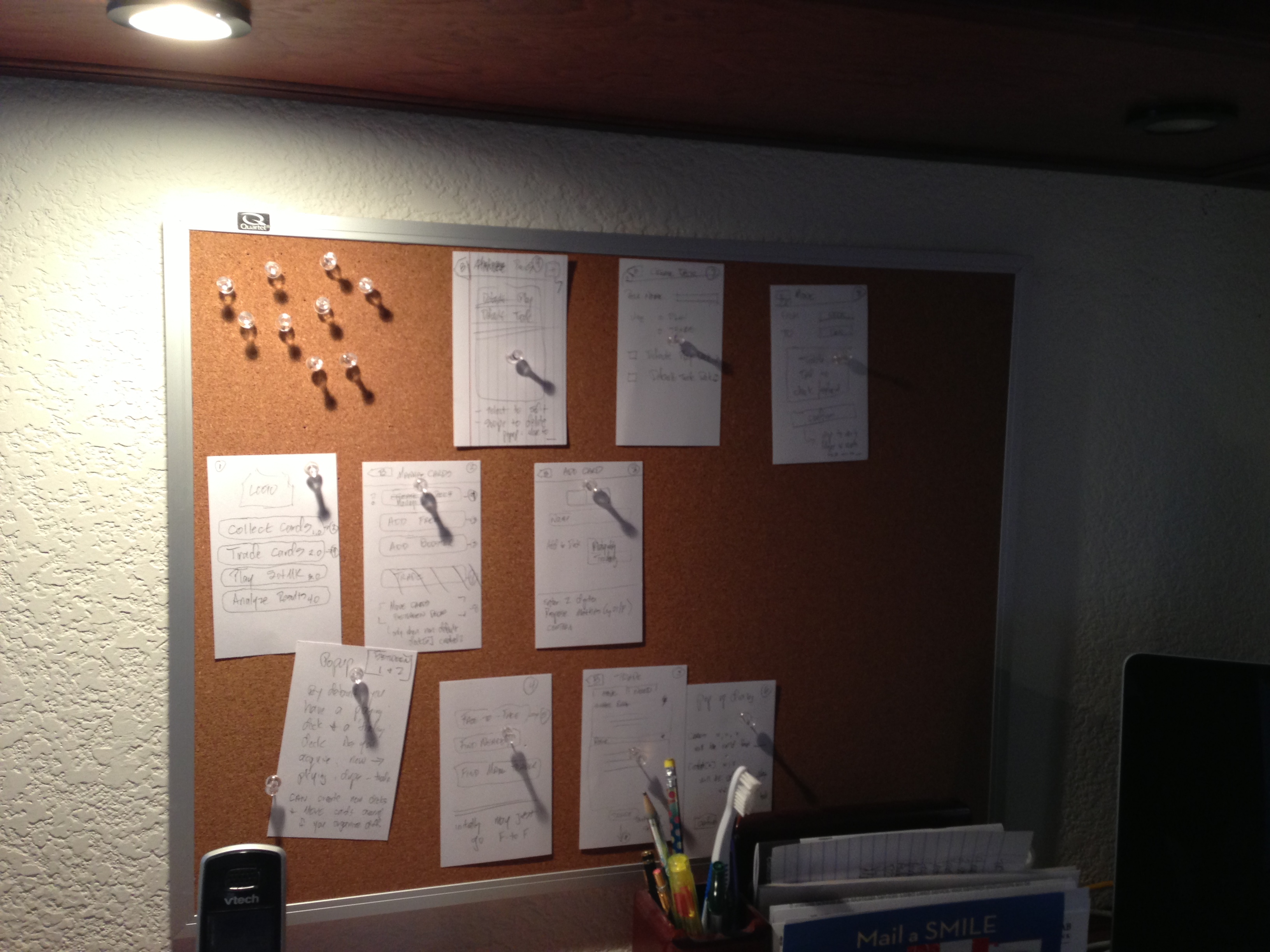
    From this idea, I was quickly beginning to mock up what such an app might look like — drawing out the various screens on index cards and pinning them to a cork board to get the flow.    It really seemed to hit the sweet spot I was looking for — here was an app with enough to it that it wasn’t trivial or worthless, but not so large and complex that it was more than a one-person job.   The app could be compartmentalized nicely, meaning that it didn’t have to be done all at once — I could easily visual several versions of the app, each adding in a few new features.    (That was a big downside to the baseball app — you couldn’t do it in pieces.   You can’t release a version 1 that only does balls and strikes, and then a version 2 that handles other batter actions, and then a version 3 that handles baserunning — until you can do it all, you don’t have anything usable).

    Inspiration had finally come along; the idea was there.   Now it was just a mere matter of programming to take the idea and make it a reality.

    Index cards being  used to mock up application screens
    Index cards being used to mock up application screens
  • A New App and a New Blog

    Yesterday my first-ever iPhone app launched in the App Store for Apple’s iOS devices (iPhone, iPad, iPod Touch).    The link to download the app is at right and also below.

    I have also created a new blog specifically for the app — I didn’t want to post a bunch of stuff here that would only be of interest to users of the app, so if you’re interested in the app, please follow The Sorcerer’s App blog to get the latest news about the app.

    But I thought it would be appropriate to post more of a personal story here of how the idea for the app came to me, and some of the fun and challenges along the way.   So stay tuned over the coming days and I’ll share some of the backstory of creating the app.    In the meantime, if you’re a player of Sorcerers of the Magic Kingdom, please check out the app.    If you aren’t yet a player but are planning a visit to the Magic Kingdom in the future, take a look and see if it’s something you want to include as part of your next trip to Walt Disney World.

    Download the Sorcerer’s Apprentice

  • Running the Inaugural Tower of Terror 10 miler

    I’ve never been a runner, so when my friend Trish initially suggested I join her in running the inaugural Tower of Terror 10 mile run, I declined.   I’d be happy to come along and cheer, I said,  but running 10 miles was not even a remote possibility.

    But despite my initial response, the idea did stick with me.   I knew I needed to be doing something for exercise.   And I’d heard good things about the Disney runs … my brother Marcus did the WDW Marathon years ago, and on various Disney discussion groups and podcasts it’s impossible to miss mention of the various runDisney events, and they always end up sounding like a lot of fun — except for the bit about actually running.

    I was intrigued enough to start poking around on the internet and looking at training plans … wondering what, exactly, I’d be committing myself to if I decided to do this.   I started, as many do, by looking at the Couch-to-5k training plan.   And I decided to start with that.   This was early January, and registration for the Tower of Terror event opened February 14th.   I figured I’d start training and see how my progression went over the initial four or five weeks, and then decide whether I could do it.

    Training

    As a non-runner, my initial progress was disappointing.   I continued to look at other resources, and picked up Jeff Galloway‘s book on my brother’s recommendation.   There I found the idea that I didn’t need to run 10 miles — I could use a run/walk strategy.    Suddenly it seemed much more feasible — I didn’t need to run 10 miles, I just needed to run a few minutes at a time, take a walk break, then run a few more minutes.     Another friend, Bobbi, recommended the Chi Running website and book, and there I found the technical details on form and technique that would allow me to train and run without injury.

    I don’t mean this to be a recap of the entire training process, so I’ll just briefly summarize.   I used Chi Running for my running methodology; I downloaded Galloway’s race-specific training plans from runDisney and decided, somewhat arrogantly, to follow the training plan for experienced runners looking to improve their time rather than the beginning runner’s plan.   I played with different run-walk intervals and eventually settled on 1 minute run, 1 minute walk.  My longest training run was 13.5 miles — shorter than what was called for in the training plan, but long enough to give me confidence about the 10 miler.   I headed to the race feeling good about my preparation.

    During the months of preparation, our running group had expanded; Trish recruited her friends Amanda and Sarah, and I recruited my brother Marcus and my ex Debbie.   So we had six runners of varying ages and abilities joining the more than 10,000 other runners ready to tackle the course the night of Saturday, September 29, 2012.

    Race Night

    Almost all of my training (and all of my long runs) had been morning runs, and all in relatively mild weather (I usually start running before sunrise with temperatures no higher than low 60s).   The ToT race was an evening race, starting at 10 p.m.   At race time the temperature was 80, as was the humidity.   While I’d rested most of Saturday, the previous days had been full-on Disney park days, and I was starting out with tired legs and a blister on one toe.    The heat, humidity, and initial tiredness made me realize I probably wouldn’t be doing this 10 miles as fast as I had done my training runs … and my training runs were really just trying to be fast enough to stay ahead of the “sweepers” who come along and pick up anyone who doesn’t keep the required pace of 16 minutes / mile.    During training I averaged about 13:30 minutes / mile for my longer runs.   I thought this would give me a cushion sufficient to allow for any slow-down due to heat, and also the opportunity to stop for photos along the way.

    Our group of runners was spread out from Corral A to Corral D, so clearly we wouldn’t be starting together.   And given our different paces and the large field, I really didn’t expect to be seeing others during the race … so it would have to be a big reunion at the after-party.

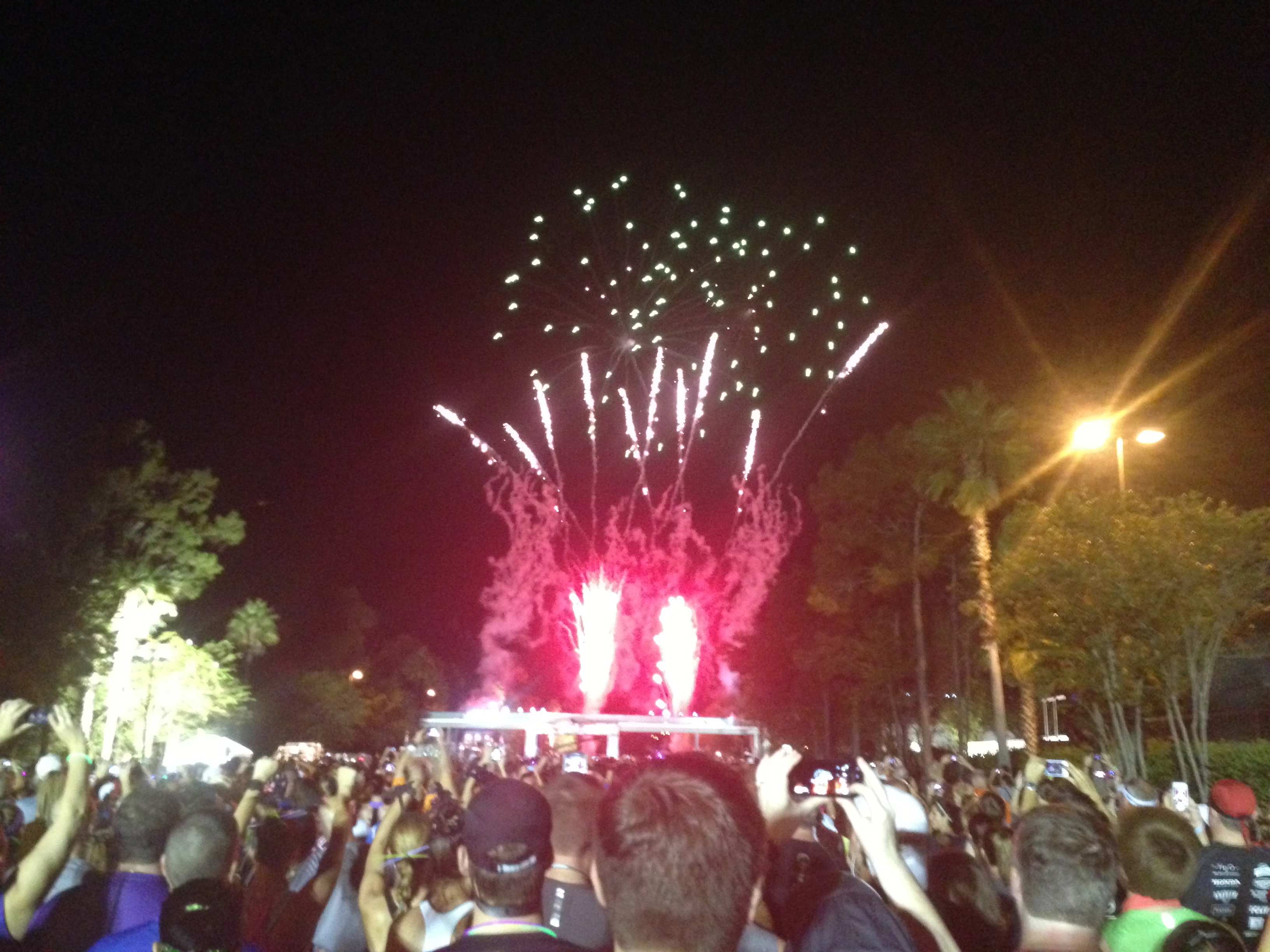
    But I was in the same Corral as Marcus, so we filed into the Corral B together to await the start.   Just after we had gotten into the corrals they started walking us out to the starting line.   There were a bunch of announcements and it seemed the time went by quickly — before long, the fireworks went off marking the start of the race for the wheelchair racers.   Just a few minutes later, the fireworks went off again and Corral A was off.   And then five minutes later, it was our turn, and the group surged forward through the parking entrance that marked the race start.

    We went straight only a little ways before making a sharp turn and heading up a cloverleaf section of the interchange between World Drive and Osceola Parkway.   I’d done some practice running hills, but the ramp was tilted quite awkwardly side-to-side which I really wasn’t prepared for.   I ended up walking a lot of the ramp and then tried to get into my rhythm once we got onto the level surface of the overpass.   We headed toward the Animal Kingdom.   When I hit Mile 1, my pace was 14:00 — that was slower than almost every training mile I’d done.   But I had planned to start out slow so I didn’t worry about it.    But as it turned out, that would be my fastest mile of the night.

    Course Map

    A little past Mile 2, we passed the entrance plaza for the Animal Kingdom.  (I can still hear “Attention Runners:  Speed bumps ahead” repeating endlessly).   After the turn we were headed back the way we came on Osceola Parkway.   It was a chance for me to see how many people were behind me, and I was happy to see I wasn’t in last place.

    The Osceola Parkway sections of the run were pretty dull, which is unfortunate since it made up the bulk of the race course.   Around mile 5 we turned off onto a narrow trail.   This was probably the best-themed area of the course, a narrow trail leading into the Wide World of Sports complex.   Spooky lighting, things hanging in trees, and music fit the theme.   But the trail was very narrow, forcing everyone down to a walk.   And the trail surface was rock and gravel — I was running in very thin-soled Vibrams so it was not a fun surface to walk or run on.

    We emerged from the trail into the bright lights of practice fields at the WWoS complex.   We ran most of the way around the quarter mile track ( a much nicer running surface! ) and made our way over to Champions Stadium, where we were “cheered” on by a handful of spectators who had come to watch.   (One sign I spotted read “Worst.  Parade.  Ever.”.   We were being broadcast live onto the JumboTron but I didn’t try to spot myself, at this point (a bit more than six miles in) I was really just focusing on moving forward.

    We finished mile 7 and headed back out to Osceola Parkway again, and turned back toward the studios.   At this point I’d slowed pretty much to a walk with an occasional minute or so of running thrown in every quarter mile or so.    Mile 8 went by, and then we started backtracking, running down the same tilted cloverleaf ramp that we’d covered at the start of the race.   Just before Mile 9 we entered into the Hollywood Studios near the Lights, Motors, Action attraction and ran in front of the bleacher seating for the show.   Right around here, Debbie, who had started 2 corrals (and 10 minutes) behind me, caught up with me and we did the last mile together.

    From there, it was down the backstage New York street, and then a turn to come down the alley way behind the American Idol attraction.   We looped our way around the Sorcerer’s Hat, thru the archway leading to Animation, and down Pixar Place.   There we turned backstage and began making our way toward the Tower of Terror finish.

    The backstage part was uninteresting and we mostly walked, but when we rounded the last turn, there was the finish line, and suddenly our legs were ready to run again.   We crossed the finish line with arms raised in victory and received our finisher’s medals from the volunteers.   Beyond this we were handed bananas, PowerAde, and a goodie box with other snacks.   Cruelly at this point we had to walk up a steep hill to get to the setup where finisher photos were being taken with the medals.

    After Party

    After the photos, we had to make our way over to the bag check which was at the Indiana Jones Adventure.   Never has it seemed so far from Tower of Terror to Indiana Jones … with the race done, all motivation to move had left me.   But we made our way over.   I made my way down the IJ steps like a 90-year old man, retrieved my bag, and sat in the bleachers for a few minutes before making my way to the changing tents.  After changing we met up with Marcus and his wife Ginny at Toy Story Mania.  We walked up to Rock n Roller coaster, where we ran into Trish.   I really wanted to do Tower of Terror post-race, but the wait suddenly went from 20 minutes to 55 minutes while we were standing around talking, and I decided to catch it another time.    As it turns out, I ended up not getting on a ride during the after-party, just standing around and talking (we eventually ran into Amanda and Sarah also, so the entire party was accounted for and everyone had finished without injury or incident).

    I was really happy to finish my first runDisney race, and I’m looking forward to the WDW half-marathon in January, where I’m hoping the heat and humidity will be friendlier and I’ll put in a performance more in line with what I’ve seen in my training.   But since it’s my first 10-miler, it’s a PR, and I’ll take it proudly.

  • Coming Attractions

    Now that the new blog is up and operational, I’m looking forward to some of the things that I’ll be blogging about here in the months to come.

    June and July will probably be light, but things will begin to pick up after that.

    In August, I’ll be attending Destination:D, Celebrating 75 Years of Disney Feature Animation, at the Disneyland Resort.   So in mid-August I’ll be blogging about

    • The D23 Destination:D Event
    • The new Cars Land expansion to Disney’s California Adventure
    • The re-themed Buena Vista Street area of DCA
    • Some fine dining experiences at Napa Rose and Carthay Circle restaurants

    Then in September, it’s off to Florida for an incredibly jam-packed week including

    • The inaugural Tower of Terror 10-mile race
    • D23’s EPCOT 30th Anniversary celebration
    • Any other in-park events for EPCOT’s 30th anniversary
    • The first weekend of the Food & Wine festival at EPCOT
    • Mickey’s Not-so-Scary Halloween Party at the Magic Kingdom
    • WDW Radio’s e-Ticket event
    • Plus other events by WDW Today and WDW Celebrations to commemorate EPCOT’s 30th.

    Then, in 2013 there will be a cruise on the Disney Dream, and the 3rd D23 Expo.  So much to look forward to!

    UPDATE: Edited 6/8/12 to add link to the D23 EPCOT Event details